Local Driving Guides
Driving in Bangalore for the First Time: Traffic, Habits and Tips
By Rental Wheelz Editorial Team · Written with AI assistance from Rental Wheelz's published fleet, pricing and policy data · 2026-10-28
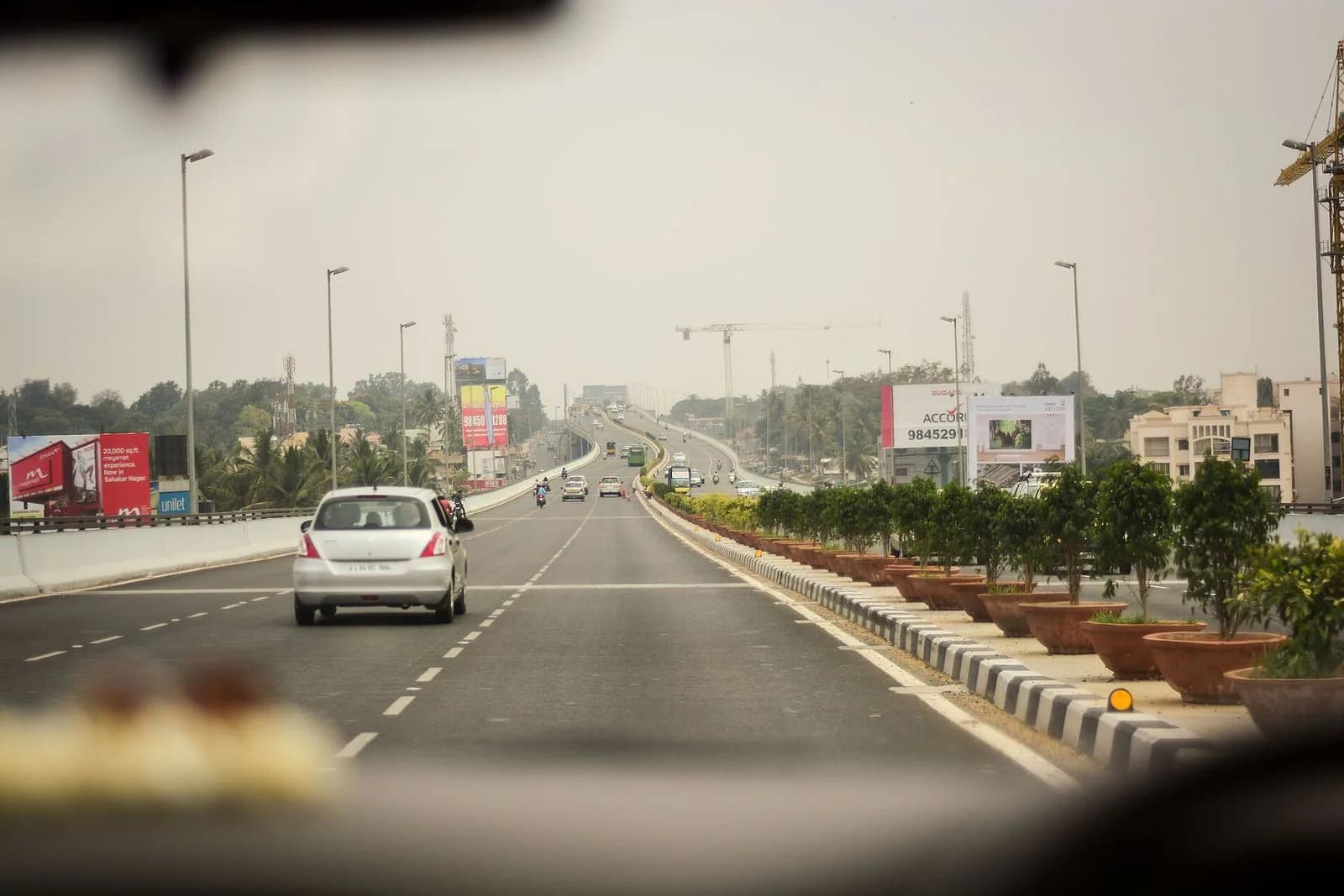
Driving in Bengaluru as a first-timer is very doable, provided the trip is planned around the city's peak windows and the first drives are short. The roads are busy, two-wheelers are everywhere, and junction behaviour is more fluid than the textbook, but most of the stress comes from timing and unfamiliarity rather than from anything unmanageable.
This guide collects general, commonly observed patterns for visitors and new arrivals. Conditions change from week to week, so treat everything here as a starting point rather than a promise.
When are the worst driving windows in Bengaluru?
For most of the city, the heaviest weekday traffic falls in the morning stretch of roughly 8:30-10am and the evening stretch of roughly 5:30-8pm. If a route crosses more than one locality, those two windows are the ones to avoid, because several local peaks overlap at once. Our guide to the best time of day to drive across Bengaluru goes locality by locality.
The pattern differs by area, which is why a single "avoid rush hour" rule is not enough:
| Area | What tends to slow it down |
|---|---|
| Whitefield | IT shift-change traffic on the ORR between Kadugodi and Hoodi, 8:30-10am and 5:30-8pm |
| Koramangala | Lunch crowds from about 1-3pm, plus weekend evenings; the Sony World Signal junction is the usual chokepoint |
| HSR Layout | Weekend restaurant parking from Friday evening; the outbound crawl towards Sarjapur Road on weekday evenings |
| Electronic City | The Silk Board approach on Hosur Road remains the main bottleneck |
| Marathahalli | Restrictions around the bridge for metro construction push traffic onto ORR approach roads |
For real, route-by-route numbers rather than a map app's optimistic estimate, see the real drive times between our service localities.
How do two-wheelers change the way you drive?
Two-wheelers make up a very large share of vehicles on Bengaluru roads, and they move through gaps that a car driver would not expect to be used. Riders commonly filter up the left or right of a stationary queue, appear alongside the car at signals, and cut across in front when a gap opens.
A few habits help in practice:
- Check mirrors before every lane change and before opening a door. A gap beside the car is rarely empty for long.
- Leave a larger gap in front than feels necessary. Sudden stops by scooters and autorickshaws are common, and a bigger gap buys reaction time.
- Hold a steady line. Predictable movement is easier for riders to read than sudden weaving, even when the road looks wide enough.
- Expect motion at the edges at a red light. Riders often creep ahead of the stop line, so pull up smoothly rather than rolling forward.
How do flyovers, junctions and lanes behave?
Flyovers and underpasses
Flyovers are used heavily to bypass signal-controlled junctions, and the merge points at their ends are where speed differences show up. Choose the lane early, because late lane changes near a ramp are a common source of sudden braking. Underpasses can collect water during heavy rain, which is covered in the monsoon driving safety checklist.
Junctions and signals
Junction flow is often negotiated rather than strictly sequenced: vehicles inch forward, make eye contact and take turns. Patience works better than assertiveness. When a signal changes, expect a short delay as the queue clears, and expect some vehicles to move at the very end of the previous phase.
Lane discipline
Painted lanes are followed unevenly. Many drivers position by the gap available rather than by the markings, so the safest approach is to follow the traffic around, stay in one lane where possible, and signal early. In India, traffic keeps to the left, which matters for visitors used to right-hand driving; roundabouts and right turns are worth rehearsing on a quiet road first.
What are parking habits like, and how do you avoid trouble?
Kerbside parking is tight in busy commercial stretches, and some roads are marked no-parking on one or both sides. Indiranagar's 100 Feet Road is a well-known example, which is the reason deliveries there go to the building rather than to a roadside spot; the full explanation is in our post on 100 Feet Road and why meeting at the kerb does not work.
Practical points for visitors:
- Look for parking signs before leaving the car, and prefer mall, building or designated lots over improvised roadside gaps.
- Weekend evenings in restaurant clusters such as HSR's Sector 1 and 2 fill early; arriving before the rush or parking a few streets away usually saves time.
- A compact car is easier to place in tight residential lanes and IT-park lots; the Maruti Swift is the smallest in the fleet.
How should navigation be set up for a first drive?
Set the route before moving off, and use a phone mount rather than holding the phone. Map apps are helpful for live traffic, but their time estimates tend to be optimistic around known chokepoints, so add margin: roughly 15-20 minutes for a route that brushes Silk Board at peak, for example.
- Download an offline map of the city in case the signal drops under flyovers or in dense areas.
- Watch for diversions. Construction around metro works changes routes regularly, and the Marathahalli Bridge restrictions are one current example.
- Keep the destination's gate or entrance in mind, not only the street name, since large campuses and apartment complexes can have several entrances.
- If a turn is missed, continue to the next safe option instead of reversing or stopping abruptly.
Is night driving in Bengaluru manageable?
Generally yes on main roads, which tend to be well lit, and late-night traffic is typically much lighter than at peak. The usual cautions apply more strongly after dark: unlit vehicles and pedestrians can appear at the edge of the road, some side streets and under-construction stretches are poorly lit, and fatigue builds faster after a long day.
Dip the headlights for oncoming traffic, slow down on unlit stretches, and avoid unfamiliar side roads at night when a main road is available. Early-morning airport runs on the highway side are usually quiet; the comparison of the Hebbal and Bagalur routes to the airport helps with route choice for those.
Which car and starting locality suit a first week?
For a first week, a compact hatchback is the lowest-pressure choice: it is easier to park, cheaper to run, and quicker to learn. The Hyundai i20 adds a quieter cabin for long ORR stretches, while a sedan or SUV makes more sense once the group size or luggage demands it. Our comparison of hatchbacks and sedans in Bengaluru traffic covers that trade-off.
The starting locality also shapes the first drive. A pickup in a quieter residential area such as HSR Layout can mean calmer first kilometres than one at the middle of an IT-park shift change. Exact pickup details are confirmed over WhatsApp after the booking enquiry, so mention any first-time nerves at that stage.
Bengaluru specific
Bengaluru sits on the Deccan plateau at roughly 900 metres above sea level.